Monday, October 26, 2015

Sine and Cosine: How do they interact?

Hello again, class!  I'd like for us to take a closer look at the graphs of sine and cosine functions. What can we learn from studying their relationship? We know that they form a circle somehow; and as one increases one decreases, but why is that? Hopefully we make life a little easier for you in the coming lessons by visualizing them.

When we study the unit circle, we see how sine and cosine are directly related in terms of x-y coordinates.  This is the rectangular coordinate system that we are used to, where we draw a grid.
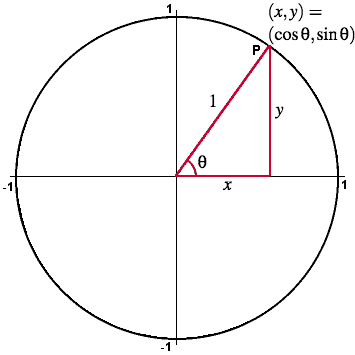
Unit Circle
http://mathmistakes.info/facts/TrigFacts/learn/images/ucdefp.gif


When we start at 0, the value of cosine is 1, and sine is 0.  As we increase the angle, we climb the circle upwards, or increase the sine.  We notice from here that the cosine begins to shrink until we hit 90 degrees, where sine is now 1, and cosine is now 0.  As we continue along the circle, sine shrinks and cosine starts going into negative values until we hit 180 degrees.  Continuing along, sine and cosine are both negative and finally, we enter the 4th quadrant where the circle closes up.

Sine and Cosine (+ and -)
http://aventalearning.com/courses/ALG2x-HS-A09/a/unit05/resources/images/A2_5_3_10_unitCircle.jpg


This relationship might be hard to conceptualize at first, but here is a brilliant image of a machine that roughly illustrates sine and cosine's relationship in the Unit Circle.

Sine and Cosine.
  http://www.businessinsider.com/7-gifs-trigonometry-sine-cosine-2013-5

Notice how this relationship continues on infinitely.  The domain, or set of inputs that defines a function, is defined for all values of theta.  That means we could calculate the sine and cosine values for -360000000 degrees, and 360000000 degrees, or any infinitely large value you could imagine.

Practice: Try putting a random number into your calculator and pressing the sin key.  For example, let's try 60.

sin(60)=0.8660254...

Let's add 360 degrees to that, or a complete turn around the circle.  360+60=420

sin(420)=0.8660254...

Let's add 360x100 to that.  360x100 = 36000+420 = 36420.

sin(36420)=0.8660254...

We get the same result!  You calculator is actually solving for unit circle values for these functions. Consider the following image as well:

Sine and Cosine
http://static4.businessinsider.com/image/51910f38eab8ea4c31000002/0tlnknd%20-%20imgur.gif

We can see, as the circle is traced, it's "shadow" or "projection" on the yz axis (drawn in red) is actually the sine function, and its projection on the xz axis (drawn in blue) is the cosine function! When we visualize it this way, we see how these infinitely occuring functions occur - it is because we can trace infinitely many circles in space.

Doesn't it look like a spring?  It's not a far stretch to assume that trig functions can be applied to physics and mechanics.  That is only the beginning - the usefulness of these functions goes on forever, just like the functions themselves.

Sound acts in waves - light acts in waves; there is so much about the world we can discover through these ideas!  Any circular pattern we observe in the world can likely be modeled and adapted to trigonometry; even those in nature.  Concepts like shadows, hours of sunlight, and even wildlife population can be studied with trigonometry.

Monday, September 28, 2015

Learning the Unit Circle

Greetings everyone, Mr. Keen here.

As we dive into Trigonometry this year, we are going to be met with a ton of new concepts.  The unit circle is one such concept which will become extremely useful in our class.  It is so useful, in fact, that it will continue to be used throughout calculus and beyond.

Some of these concepts seem strange to work with at first; maybe even intimidating.  Instead of polygons, we start seeing curved functions like sine, cosine and tangent, which suddenly seem a lot more difficult to work with.  The circle is an easy and familiar shape though.

We have a good handle on working with rectangles and right triangles. The unit circle is really no different: we are just looking at right triangles from a new perspective. The definition of a circle is all points equidistant from its center, with the distance being r (the radius). We know 2πr is the circumference of any circle, and the unit circle is simply a circle with r=1, giving us a circumference of simply 2π.

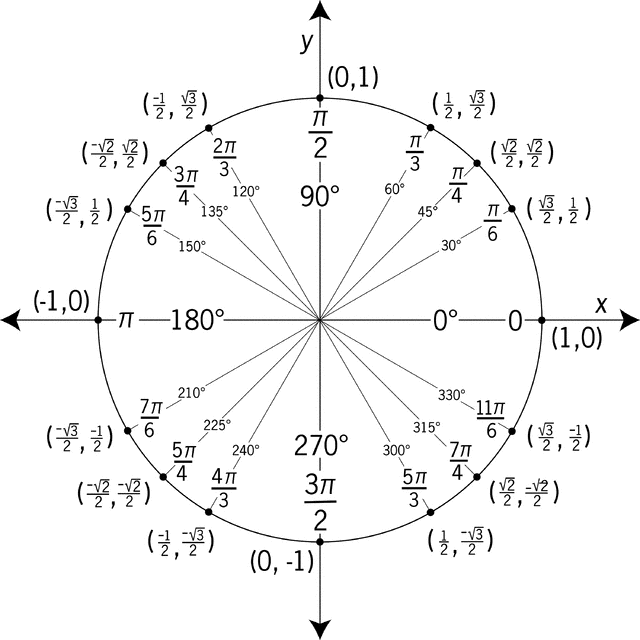
When we draw the unit circle at the origin (0,0) it is divided into four 90-degree quadrants.

Unit Circle: http://etc.usf.edu/

The beauty of the unit circle is you only need to memorize the first quadrant.  We have 5 angles to work with, which are 0°, 30°, 45°, 60°, and 90°.  We can trace a right triangle over all of these.

Lets look at 0°.  On a coordinate plane, we simply get the point (1,0) - this is because the radius (1) is going straight in the x direction.  Easy, right?  We can always think of cosine as the "x" value and sine as the "y" value in rectangular coordinates.  When I was in school I was taught to memorize all of these values, but simply knowing this x - y relationship is more than half the battle.  If you understand this, you're better off than I was in college.

Remember in Geometry how we found sine and cosine with SOH-CAH-TOA? Sine=Opposite/Hypotenuse and Cosine=Adjacent/Hypotenuse.  Well in the case of the unit circle the hypotenuse (which is always the radius) is always 1, therefore we can ignore it.  So sin=opposite, cos=adjacent, or sin=y, cos=x.

Circle Diagram: Unit Circle & Evaluate Trig Functions - Mr. Gais


Let's look at 30°.  Notice it is further in the x direction than the y direction.  We see (√3/2, 1/2). Notice √3/2 is a larger quantity than 1/2, and in the y direction it appears to be halfway up the circle, as we would expect.

Let's look at 45°.  This forms a 45°-45°-90° isosceles triangle, so the x and y values are the same!    It happens to be (√2/2, √2/2), which is the only other number you need to memorize!

Finally let's look at 60°.  This angle is very similar to 30°, but the x and y values are switched, giving us (1/2, √3/2).

The angle 90° is much like 0°.  There is no x value, and the y value is simply 1, because it is the radius going straight up in the y direction touching the very top of the circle, giving us the point (0,1).

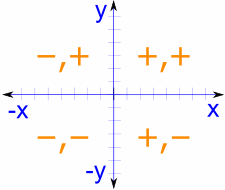
Now that we have these values, we can easily illustrate the rest of the unit circle by placing negative signs in the appropriate places.  In the 2nd quadrant, the x value is negative, but the y value stays positive.  In the 3rd, both are negative; in the 4th, x is positive and y is negative.

Quadrants: MathIsFun.com
Q1: (+,+)
Q2: (-,+)
Q3: (-,-)
Q4: (+,-)

That's all there is to it!  We will practice soon with reference angles, but let's do a quick example ahead of time.

Find the unit circle values for 225°.  Let's think for a moment.

225° ends with a 5.  Surely our best guess would be that it is a reference angle of 45°, since 225° isn't divisible by 30° or 60°.  If we visualize it, we rotate counterclockwise starting at the angle 0.

Image from http://math.stackexchange.com

180° is halfway around the circle.  225°-180° = 45°.  If we go 45° further along the circle, we arrive in the 3rd quadrant with a 45° reference angle.  The unit circle value for a 45° angle is (√2/2, √2/2).  Since we are in the 3rd quadrant, both values are negative, thus our answer is:

(-√2/2, -√2/2)


As long as you know how far from 0 or 180 the angle is, you can easily find its unit circle values.

For those who like to use their hands to help visualize, there is an amazing trick that makes learning the unit circle as easy as counting 1,2,3; literally.  YES you can use this during a test! Here's how:


Left Hand Trick - https://www.youtube.com/watch?v=LE6dmczMc68


Sources:

Gais, J. (n.d.). 2.0 - Unit Circle & Evaluate Trig Functions - Mr. Gais. Retrieved September 28, 2015, from https://sites.google.com/site/mrjgais/Home/trigonometry/unit-circle 

Pruitt-Britton, M. (n.d.). Memorizing the Unit Circle Using Left Hand Trick. Retrieved September 28, 2015, from https://www.youtube.com/watch?v=LE6dmczMc68 

Rajpoot, H. (n.d.). Calculating a Point that lies on an Ellipse given an Angle. Retrieved September 28, 2015, from http://math.stackexchange.com/questions/22064/calculating-a-point-that-lies-on-an-ellipse-given-an-angle

Trig Unit Circle Why? (n.d.). Retrieved September 28, 2015, from https://www.physicsforums.com/threads/trig-unit-circle-why.475575/ 

Unit Circle. (n.d.). Retrieved September 28, 2015, from 
http://etc.usf.edu/clipart/43200/43215/unit-circle7_43215_md.gif